Friday, January 17, 2014

Squirrel defense

Squirrels apparently like to dig in nice soft dirt. This is a problem for my newly planted beds.

This rose clearly needs a massive pruning

I bet the thorny branches would make a mean mulch. 

And I also hear the don't much like this stuff:

So I will try sprinkling that over the soil surface. 

What else can I do to discourage squirrels from digging up and ruining my freshly-planted beds?

Friday, January 10, 2014

Infinite Lettuce?

So, about a bajillion people on pinterest have posted links to articles like this and this, in which the writers say that you can take the stump left from a head of romaine lettuce and re-root it and re-grow more lettuce from it.  Which suggests that at least some types of lettuce are pretty sturdy.

Also I see articles like this one about "cut-and-come-again" harvesting of loose-leafed lettuce, in which  you just chop off the top portion of the lettuce head and leave it and it'll grow back from the base.  This seems rather consistent with the ability to grow back again from the stump, so I'm starting to see a pattern here.

And it sure seems like it would let you get more lettuce from less space, if this approach works - I strongly suspect that a lettuce stump with an established root system would grow back to harvest-able size faster than a new head would grow from seed, right?

So just tried it.  Went outside, whacked off the top half of the three lettuce heads that are currently big enough to harvest, and made a nice salad (yum!).

We'll see what happens - whether it grows back, and how long it takes.  I'll be sure to report back here!


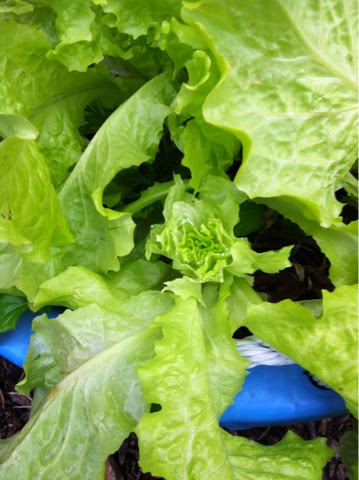
Close-up of chopped off lettuce.  Tried to cut it high enough that the smallest of the developing new leaves would be un-affected.  I left a couple of the outer leaves as well, mostly because they seemed a little beat-up and weren't appealing for salad. 

Whacking down a few of the plants gives others space to spread out (there were five plants in this clump and I cut back three of them). In a perfect world I can imagine that now the remaining two will have a growth spurt because of their new space to spread out, and then as the three re-growing plants get bigger, I can cut down the two big ones to make space, and continue to alternate so as to maximize the lettuce harvested from this little space.  

Sunday, November 17, 2013

Preparing a bed

Here is a bed that I have dug out all the previous soil and am going to start fresh.

Last year I started two nearby beds with a very high amount of compost in the soil. Between the compost breakdown and whatever was pulled from the soil into the plants, both beds had their level of soil sunk to almost half by end of season. 

So, what can I do to make this the best soil possible?  And to meet the various plans and goals I have developed?

First I am going to put some daffodil bulbs around the edge and then excavate deeper in the center - until I hit Texas Gumbo soil. 

Next some gypsum along the gumbo in hopes of improving that layer of clay. 

The next layer is a bunch of raw uncomposted stuff - clippings, leaves, whatever - from my "recently gathered" pile. Goal is to fill to about half the height of the bed but since fresh clippings can be fluffy, I eyeball how much I think it will squish down. 


Next comes compost from my oldest pile - the stuff closest to finished. If available. If there is not enough of that then I go  straight to topsoil. Don't want recent weed seeds or fungus in the top inches of soil. 

At this point if you press in the soil you learn it is still quite fluffy and bouncy. That's good in a way since aerobic composting is faster. But it means you'll need to mound up the final soil layer so that you won't end up with a half-full box. 


At this point it is best to let this sit a season, or perhaps plant something outside your rotation scheme such as an annual herb. However I have been know to plant directly into these beds; they seem to do OK as long as the top soil later will sustain your plant until the bottom stuff rots. It'll do better if you add fertilizer from time to time. 

I try to keep boxes in the rotation scheme even if I end up refilling them before the end of the scheme. In this case for example, the two original boxes contained tomato-family plants. So I made sure the box that got the combined soil got planted with the next thing in cycle - legumes and cabbage family. And the newly filled box can have all my leftover onions (somehow when I buy a batch of onion starts it is always too too many) and in the spring I will move it to the legume/cabbage phase. 

As a final step I pile a whole bunch of freshly-clipped basil on top of the soil. This is an experiment to see if the pile of leaves and branches will help this bed avoid the attentions if digging squirrels. Of course if it results in me getting a nice volunteer fall crop of basil among my onions I will not mind a bit!  

Friday, October 4, 2013

Soaking seeds

Last spring I accidentally left my box of seed packets outside, and they got rained on. Realizing that they were therefore probably ruined, I hurriedly planted every single seed, sometimes hands full at a time, in every corner of the garden as well as in dozens of old pots. 

Imagine my surprise when almost all came up with a way better germination rate than I had ever before experienced!

So I did a little research and sure enough, lots of folks recommend soaking seeds before planting. Recommendations vary from a few hours to overnight. 

So I am trying it this fall. The night before I intend to do any planting, out comes all the little tupperwares:

The first time I tried this was a couple of weeks ago. And after an overnight soaking, what did I see on a bunch of the seeds?

Tiny little sprouts already emerging!  So I was as gentle as I could be, tucking those in the ground. 

Results?  No pictures but most everything showed signs of germination within the first week, some within a day. 

Now if I could get the squirrels to stop digging holes in my freshly planted beds, maybe I could manage to have a real garden!

Wednesday, September 25, 2013

Crop rotation part 2: Nightshades, alliums, beets and spinach and basil

So here are some issues to be grappled with to carry out my rotation scheme:

1.  Balance.  I usually want far more tomatoes and peppers and eggplant and such than I could fit in four little boxes.  But if I do more than four, then the following year I'll have an over-abundance of some other thing.  So will start my planning at four and see what happens - perhaps will do additional boxes of nightshades which then roll over to compost immediately instead of going on with the rotation?  Have also noticed that the soil level drops a lot after the first "composting" year, probably because so much of the bulk in the box was organic matter breaking down.  So... maybe do a couple extra boxes of nightshades, and at the end of the season, dig the dirt in them out to top off the remaining boxes, leaving a couple extra boxes for compost management and launch the following year?  Also worth noting that peppers often survive the winter in which case they might be "permanent" boxes instead of annual/rotation boxes. 

2.  Sorting out spring and fall.  Really in Houston one should be able to get both a spring and a fall crop of tomatoes.  So where is the room for beets and spinach?  I'm thinking that these things just get planted around the base of the tomato plant in the fall, along with onions since they're also cold-season growers.  And in spring, could do a very early spinach crop to be harvested in time for a late spring basil crop around the base of the plants.  So then there's the question about planting the same box spring and fall... which I think I'll try doing since the fall crop would be expected to be a pretty short one and hopefully can produce before the fungus takes over.

3.  Determinate versus indeterminate - I always wondered why one grows determinate varieties.  I mean, the idea is to have a steady supply of fresh veggies, not a whole slew at once, right?  But as I think about it, I realize that every year, I get only a short window of produce before it gets super hot and the indeterminates stop producing.  By fall they're so beat up and gross that I want to start fresh with new plants.  So if I planted determinates maybe I'd end up with more total tomatoes.  Clearly the thing to do is experiment.  So, I have planted both this fall:
Indeterminates along the fence, a variety called "Early Girl" which is supposed to mature in 50 days which ought to get me fruit before we get any freezing temperatures, and 
A nice experimental determinate vine, "Celebrity", on the patio which said 65 days to harvesting - again, it should be safe to get something harvested before there's a freeze.

Around these I will plant some onion sets and spinach and beet seeds.  Maybe intersperse the spinach and beet plants, assume that the spinach gets harvested as the beets get bigger? 

Tuesday, September 24, 2013

Crop rotation for the semi-tropics

The home desktop died and hasn't yet been replaced, which has made it inconvenient to post.

But haven't been entirely idle even though the summer heat has encouraged me to spend a lot of time just trying to hibernate.

Got in a bit of fall gardening yesterday.  Am still really trying to teach myself to do this effectively; my childhood gardening experiences only take me so far in learning what one has to do to effectively grow fruits and veggies here in Houston.

So.  The first set of research has been around the idea of crop rotations.  Seems like everything is vulnerable to something - tomato plants get fungus, squash or cucumbers succumb to borers, slugs and snails munch the cruciferous veggies and lettuce.  Crop rotation is supposed to help reduce the problems with the tomatoes anyway.

Surfing google tells me that people use rotations that cover three or four years.  The idea is that by three or four years, soil fungus and bug eggs/larvae have probably died off, leaving soil that won't just attack and eat up that particular type of plant.  Problem is, most sources do not assume the ability to grow two crops (spring and fall) every year.  So I have to think it through a bit better.

SO after quite a bit of reading about what different things need and shuffling ideas around, I am ready to try a four-year cycle that entails pairs of plant families, with spring and fall coverage.  Or rather, a three-year cycle with a rest and recharging in the fourth year. 

In this post I'll outline the basic rotation; then plan future posts to talk in more detail about each grouping and what I plan to try with each.  The tentative plan assumes I have 16 boxes but of course could expand or shrink this number; just needs to be a multiple of 4.  For my yard plan, I've mostly gone with small planting beds - 2x2 raised wood beds, or larger-sized plastic tubs with the bottoms cut out.  So four of my little boxes is like half of one of the standard 4x8 raised beds you see on a lot of plans. 

So here's the mighty rotation, in picture form:


And if that doesn't come through clearly here's the brief list:

1.  In the first year of the rotation, I plan to pair nightshades (tomato, pepper, eggplant, pepper, etc) with the beet and spinach family, and also slip in alliums (garlic, onion, chives) and basil as companion plants.  Lots of additional detail and planning to do here, but tomato fungus is one of the primary reasons I've started this whole rotation idea.

2.  In the second year, those boxes would go over to some mix of brassicas (kale, kohlrabi, broccoli, radish, etc) and legumes (beans and sugar snap peas).

3.  For year three, those boxes would now be filled with some combination of cucurbits (squash, cucumbers) and for the cooler weather there's parsley and carrots (who knew those were in the same family?) and lettuces.

4.  And, the fourth year is a chance to plant odd-ball families like sweet potatoes (did you know they're actually related to morning glories), and give the boxes at least one season of rest during which I will add a bunch of compost to raise up the soil levels in the box, maybe plant a nitrogen-fixing cover crop like alfalfa or clover to prevent weed growth and further enrich the soil.

One thing I like about this plan is that it gives me a good place to KEEP compost to minimize the amount I have sitting around in bins.  Emptying the compost bin into the beds and covering the compost with a pretty cover crop strikes me as a good solution to help handle the influx of yard clippings in spring and leaves in fall. And by using all that material more effectively I hope to lessen my contribution to city landfills, and also decrease my need to purchase soil or compost from the local big box store.

In reality, this plan won't be a stable "rotation" for many many years.  For one thing, I haven't half finished my plans for building out the garden design.  And things will also need to shift around to accommodate other changes, like my fruit trees getting bigger.  In the end I expect to have more than 16 little planting boxes available for edibles around the yard, which is a good thing because I'll need additional boxes to house perennials and herbs (rosemary, lemon grass, thyme, sage, oregano, mint, etc) as well as natural biennials (parsley) and annual veggies that inexplicably decide to become perennial in my yard, like these broccoli plants that have cheerfully ignored two hot summers now including one of the worst droughts we've seen in decades:

So yeah, that's the plan.  More ruminating on it later.

Saturday, June 29, 2013

Daffodils

The daffodils I planted a few years ago have naturalized and spread admirably.  So I was digging up some stubborn patches of weeds and BOOM suddenly I was looking at a motherlode of fat bulbs:


So quickly googled what to do about this and here's the plan:
  1. Spread them out to dry a bit, then brush off the dry soil.
  2. Put them in a mesh bag and hang them somewhere out of the sun and away from severe heat or moisture.
  3. This fall, plant them.
It occurred to me that I could plop them at the base of a new raised bed, they'd be down below where I generally dig to plant seeds or place seedlings.  And they would add some cheerful pops of color in the fall/winter/spring.  If I do a four-year crop rotation cycle, and then dig out the bed at the end of the four years, that should be a pretty good cycle to dig and divide the bulbs anyway, right?

I googled a bit to see if there's any "companion plant" issues with growing them in with veggies and found nothing.   So, I think it's a plan.